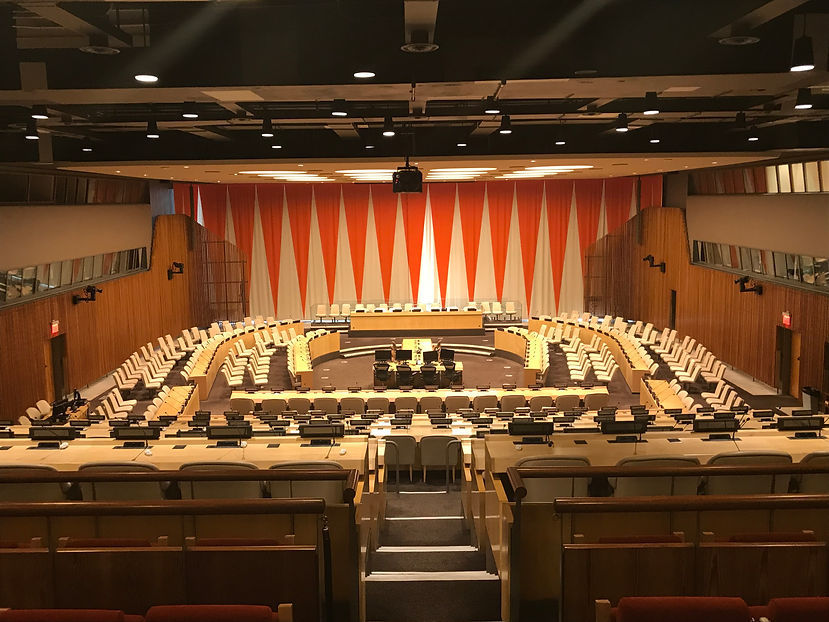
United Nations Economic and Social Council
(ECOSOC)
The United Nations Economic and Social Council (ECOSOC) was founded in 1948 to promote international cooperation for common solutions to major world problems, providing analytical work, supporting intergovernmental processes, and assisting countries with capacity development. ECOSOC is built on three major pillars: Intergovernmental Support, Analysis, and Capacity Building. Intergovernmental Support: by facilitating major global conferences and summits in the economic, social and environmental fields, as mandated by UN Member States, ECOSOC assists countries as they find common ground, set norms, and take decisive steps forward. As the think tank of the UN, ECOSOC generates, analyses, and compiles a wide range of economic, social, and environmental data and statistics to inform and advise Member States and other stakeholders as they take stock of trends and explore policy options to tackle common problems. Capacity Building: UN DESA assists in translating policy frameworks developed in UN conferences and summits into programmes at the country level and, through technical assistance, supports Member States in building national capacities.
In this GA, delegates must work together to develop solutions for moving forward globally. Delegates will evaluate the SDG goals, specifically the failures, and propose new solutions on how the world will shape economically and socially. Additionally, delegates will take a global stance on AI and the rapid effects it has.
The GA is a beginner-rated and will follow all standard procedures of a General Assembly.